Booking a Kenya Safari? Don’t Get Scammed!
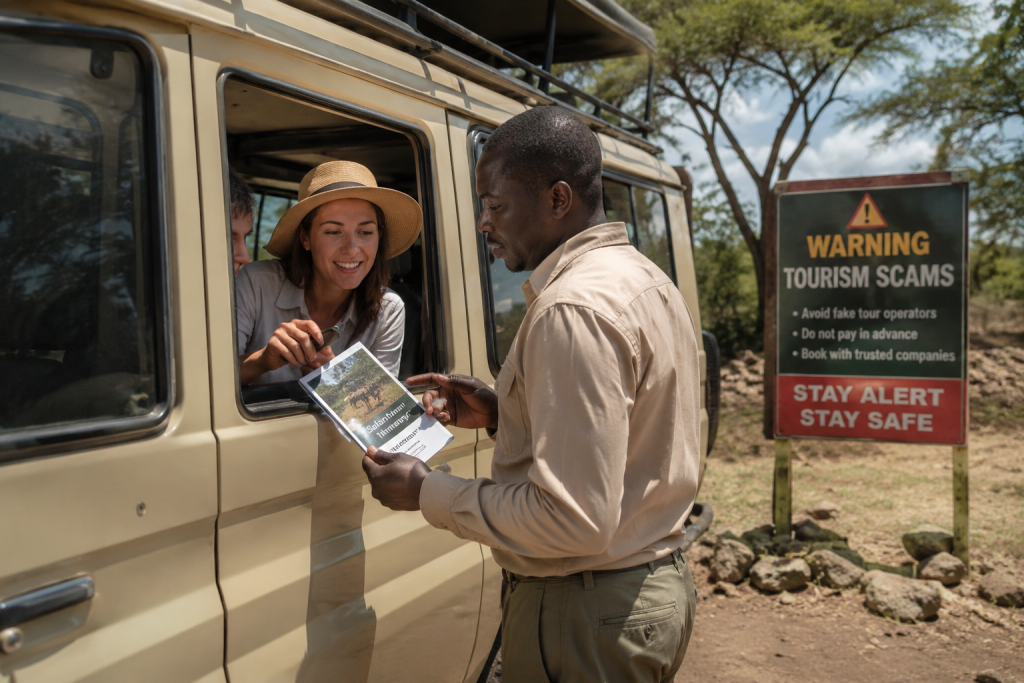
How to Avoid Fake Tour Operators in Kenya
A beautiful safari website does not automatically mean you are dealing with a legitimate tour company. Verify first. Pay later.
Booking an African safari online should be exciting. Unfortunately, for some international travelers, it becomes a costly lesson after they send a deposit to someone claiming to be a safari operator—only for the person to disappear.
Fake websites, copied safari itineraries, stolen photographs, fake reviews and convincing social media profiles can make fraudulent operators look completely genuine.
Before you send money for your Kenya safari, take a few minutes to verify who you are dealing with.
The Golden Rule: Verify Before You Pay
Never make a safari payment simply because someone has sent you an attractive itinerary or offered a great price.
A professional-looking website is not proof that a company is legitimate.
A scammer can create a website, Facebook page, Instagram account, WhatsApp Business profile and even fake customer reviews.
Instead, follow a simple rule:
Request. Verify. Confirm. Then Pay.
This can significantly reduce the risk of losing your money.
1. Ask for the Company’s Legal Details
Before making a deposit, ask the safari company for its official business information.
You should request details such as:
- Registered business/company name
- Business registration number
- Tourism Regulatory Authority (TRA) license number
- Physical office address
- Official company email address
- Telephone number
- Payment details showing the correct business or company name
- Written safari quotation and itinerary
A legitimate operator should not be uncomfortable with reasonable verification questions.
For tour and safari operators in Kenya, TRA licensing is particularly important. The Tourism Regulatory Authority regulates tourism businesses in Kenya, and tour or safari operators fall under its Class C licensing category.
2. Verify the TRA License Yourself
Do not simply look at a PDF license sent to you and assume it is genuine.
A fraudulent person can send you a modified or completely fake document.
Instead, take the license or file number provided by the company and verify it directly through the Tourism Regulatory Authority’s official license verification system.
TRA provides an online system where travelers can enter a company’s license file number or other requested information to verify tourism license details.
Verify a Kenyan tourism license through TRA
This is one of the most important checks you can perform before paying a safari deposit.
Also remember that a tourism license is not something you check once and forget. TRA states that tourism licenses expire on 31 December each year and must be renewed.
3. Verify the Company’s Business Registration
Ask the company for its registered business name and registration number.
Then independently verify the information through Kenya’s official Business Registration Service (BRS) systems.
BRS explains that an official search for a private limited company can be conducted through eCitizen using the company’s registration name or number.
Kenya Business Registration Service
The important point is this:
Do not rely only on documents sent to you by the person asking for your money.
Request the information, then independently verify it through the relevant government platform.
4. Check Whether the Information Matches
This is where many travelers can catch suspicious operators.
Compare the information across everything the company has provided.
Does the:
- Company name match the registration?
- TRA license belong to the same business?
- Bank account name make sense?
- Email address match the company?
- Website show the same company details?
- Physical address exist?
- Phone number appear consistently?
- Safari quotation show the same legal/business identity?
If the person communicating with you says they represent ABC Safaris Ltd, but the payment account belongs to an unrelated individual with a different name, stop and ask questions.
There may be legitimate explanations in some situations, but you should not proceed until the payment arrangement has been clearly explained and independently verified.
5. Be Careful With Extremely Cheap Safari Deals
Everyone loves a good deal.
But an unusually cheap safari should make you investigate—not rush to pay.
Scammers often use attractive prices to create urgency:
“Only two spaces remaining.”
“Pay today to secure the price.”
“The offer expires tonight.”
“Send the deposit immediately so we can reserve your accommodation.”
Do not allow pressure to replace due diligence.
Compare several reputable operators and ask what is included in the price.
A safari quotation should clearly explain important components such as accommodation, transportation, park fees, meals, activities and other inclusions or exclusions.
6. Don’t Let WhatsApp Be Your Only Verification
WhatsApp is widely used by legitimate African tour operators and is a convenient way to communicate with clients.
The problem is not WhatsApp itself.
The problem is when WhatsApp is the only thing you can verify.
A person can create a WhatsApp account using a company name and logo without actually representing that company.
Before booking, make sure the WhatsApp conversation connects to a real, verifiable business with an official website, registration information, tourism license and other independent evidence.
7. Check the Company’s Online Presence Carefully
Search for the company yourself.
Don’t only click the links they send you.
Search the company name on Google and look for:
- Google Business Profile
- Independent reviews
- Social media history
- Website history and consistency
- Travel industry profiles
- Mentions by other organizations
- Customer reviews outside the company’s own website
Look for patterns rather than one or two reviews.
A genuine company should normally leave a trace across multiple online and offline sources.
However, remember that online reviews alone are not proof of legal registration. Use reviews as one part of your verification process, not as a replacement for checking government records.
8. Ask for Documents-Then Verify Them
There is nothing wrong with asking a safari operator for documentation before making a substantial payment.
You can politely say:
“Before I make the deposit, could you please provide your company registration details and current TRA license information so I can verify them?”
A legitimate operator should understand why an international traveler wants to protect their money.
But there is an important distinction:
Receiving a document is not the same as verifying a document.
Ask for the information.
Then independently check it. For example ask for the company TRA certificate and verify it on the TRA website here.
9. Pay the Deposit Only After Verification
Once you have confirmed that the company exists, is properly licensed and the information matches, you can proceed with your booking.
Before paying, make sure you have received:
- A detailed itinerary
- Written quotation
- Payment terms
- Cancellation/refund policy
- Confirmation of what is included
- Company payment details
- Booking confirmation procedure
Keep copies of everything.
Save the emails, WhatsApp conversations, quotations, invoices, receipts, payment instructions and documents provided by the operator.
These records can become extremely important if something goes wrong.
What If You Have Already Been Scammed?
First, do not panic and do not delete the conversation.
Preserve all evidence.
Take screenshots and save:
- WhatsApp conversations
- Emails
- Website addresses
- Social media profiles
- Phone numbers
- Names used by the individual
- Company names
- Bank/payment details
- Transaction receipts
- Invoices
- Safari quotations
- Copies of documents they sent
- Advertisements and posts
- Any promises made regarding the safari
Do not confront the scammer aggressively or threaten them. Preserve the evidence and report the matter through the appropriate channels.
If the Company Claims to Be a Kenyan Tourism Business
If someone claims to operate a tourism business in Kenya, you can report suspected regulatory issues to the Tourism Regulatory Authority.
TRA provides regulatory and licensing services for tourism businesses and maintains systems for verifying tourism licenses.
If the operator is falsely presenting itself as a licensed tourism company, provide the relevant evidence when making your complaint.
If You Have Lost Money Through an Online Scam
If you believe you have been defrauded, particularly through online communication or electronic payment, consider reporting the matter to the Directorate of Criminal Investigations (DCI) or the appropriate police authorities.
DCI states that its investigative mandate includes cybercrime, financial crimes and online fraud.
DCI’s public complaints guidance states that members of the public can present complaints at DCI offices, Regional/County/Sub-county Criminal Investigations Offices or police stations. It also provides a public complaints channel.
DCI also advises the public to report crime through its Fichua kwa DCI channel. Its published information gives the toll-free number 0800 722 203, available 24/7, for reporting crime or credible information.
Report a complaint to the Directorate of Criminal Investigations
If money has recently been transferred, also contact your bank, card provider or payment service immediately and explain that you believe the transaction is fraudulent. Ask what recovery, recall or fraud-reporting options are available.
The sooner you act, the better.
If the Person Is Not Registered at All
This is especially important.
If someone has taken your money while pretending to operate a legitimate safari business, and your investigation shows that the claimed company does not exist or is not properly registered/licensed, don’t simply accept the loss.
Document everything and report the matter to the appropriate authorities. I.e the Kenya Tourist Police Unit.
The fact that the scammer used a website, social media account or company name does not make the business legitimate.
Likewise, discovering that a person is unregistered does not by itself prove every interaction was criminal—but if money was obtained through deception, report the circumstances and provide the evidence to investigators.
A Simple Pre-Booking Safety Checklist
Before paying your safari deposit, ask yourself:
☑ Have I verified the company’s business registration?
☑ Have I independently verified its current TRA (Tourism Regulatory Authority) license?
☑ Does the company information match across its documents, website and payment details?
☑ Have I checked independent reviews and online presence?
☑ Have I received a detailed written quotation and itinerary?
☑ Do I understand the cancellation and refund terms?
☑ Have I confirmed exactly where my money is being sent?
☑ Have I saved all communication and booking documents?
If you cannot confidently answer these questions, don’t pay yet.
A Safari Should Create Memories—Not Financial Losses
Kenya welcomes travelers from around the world, and thousands of visitors enjoy genuine, professionally organized safari experiences every year.
The existence of scammers should not stop you from experiencing Africa.
It should simply encourage you to book intelligently.
Take your time. Ask questions. Request documentation. Verify information independently. Confirm the company before sending money.
At Zuru Tena Adventures, we believe travelers deserve transparency and confidence when planning their African adventure. Your safari should begin with excitement – not uncertainty about who has your money.
Remember:
VERIFY FIRST. PAY SECOND. SAFARI THIRD.
If you are planning a Kenya safari and would like a quotation, you can contact Zuru Tena Adventures for a free safari inquiry.
🌐 zurutena.com
📧 contact@zurutena.com
Zuru Tena Adventures – Tour Again. Experience Africa Differently.